
On 3 September 2026, the Home Secretary laid a new Statement of Changes to the Immigration Rules before Parliament.
The written ministerial statement that accompanies it describes the first set of changes as "Changes to Appendix Skilled Worker to support victims of modern slavery".
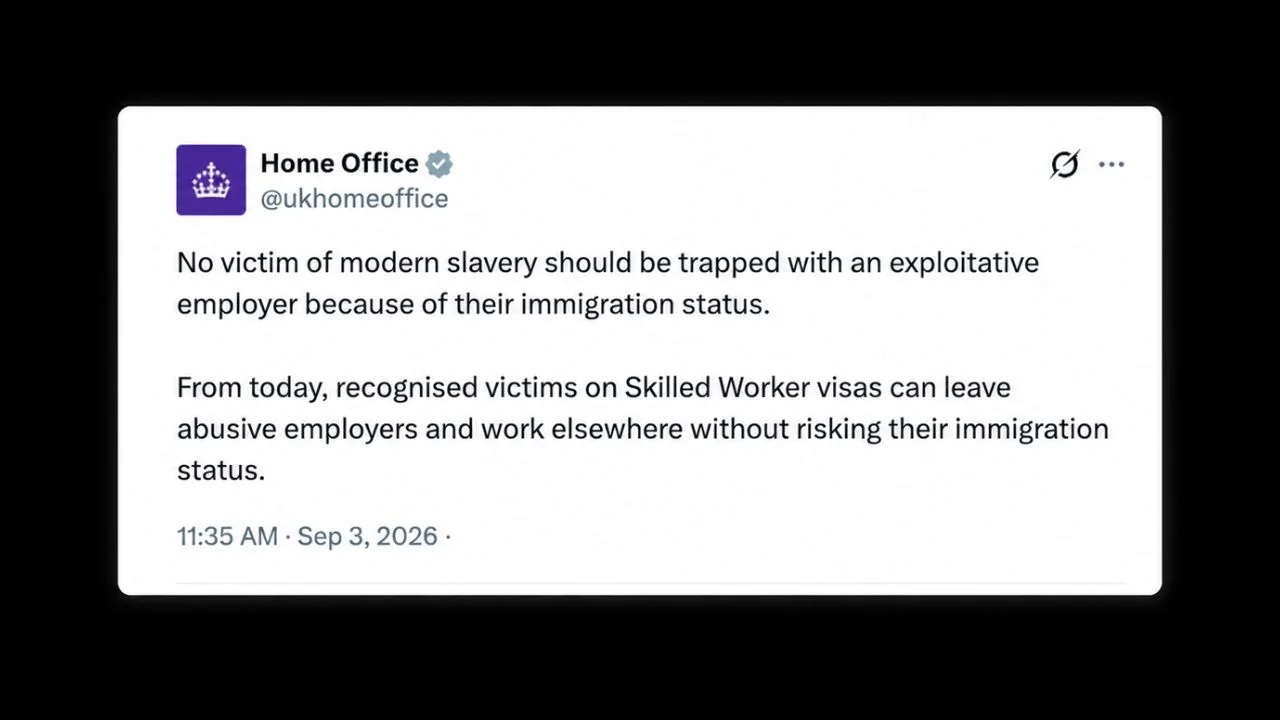
The Home Office posted about the change on X the same day.
The post said that no victim of modern slavery should be trapped with an exploitative employer because of their immigration status, and that from today recognised victims on Skilled Worker visas can leave abusive employers and work elsewhere without risking their immigration status.
Jo White, Parliamentary Under-Secretary of State for Migration and Citizenship, was quoted in press coverage saying the changes will give victims the freedom to leave abusive workplaces and rebuild their lives, and that rogue sponsors who exploit workers will face the full force of the law.
What is changing
Under the current rules, the immigration status of a person on a Skilled Worker visa is tied to a sponsoring employer. As the Guardian reported, workers on this route have no recourse to public funds and risked having to leave the UK if they lost their job and could not quickly find a new sponsoring employer.
According to the written ministerial statement, the changes will allow victims who entered the UK legally and have been recognised as victims of modern slavery to undertake work in any occupation for the remaining duration of their visa validity. Home Office officials were reported as saying such a worker would be allowed to work for any employer for the remainder of their visa.
Press reports state that the restriction tying a worker's immigration status to a specific sponsor will be lifted where the worker receives a positive conclusive grounds decision through the National Referral Mechanism, the UK's framework for identifying and supporting victims of modern slavery and human trafficking.
Ministers have said the change is aimed at workers such as care workers, chefs and hospitality staff who came to the UK in good faith and faced abuse. Where evidence of criminality is identified, sponsors will be referred to the police.
The Home Office has not yet published the text of the Rules changes or guidance on what a worker in this position would need to do.
Why the Home Office is doing this
The ministerial statement says the Home Office has seen instances of Skilled Worker visa holders who entered the UK in good faith, complied with the terms of their visa and experienced exploitation. It describes this as unacceptable.
It also gives enforcement figures. According to the statement, UKVI has revoked more than 7,500 sponsor licences to date, including 1,800 in the care sector. The Guardian has reported that more than 6,600 sponsors have lost their licences since the current government took office, with more than 4,400 of those in the year to June 2026, a 140% rise on the year before.
The statement adds that the Home Office recognises there is more to be done to ensure victims are protected and supported by the immigration system, as set out in the Immigration White Paper. The government has also said it committed in the White Paper to making it easier for sponsored workers to change employer.
On the purpose of the change, the statement says it incentivises victims to come forward early and guards against those who seek to weaponise the sponsorship system in order to exploit vulnerable workers.
When it applies
The Home Office post on X and press coverage say the change applies from Thursday 3 September 2026. The written ministerial statement says the Statement of Changes as a whole comes into effect on 8 October 2026, 29 October 2026, 30 November 2026 and 9 December 2026, as detailed in the Statement of Changes, and does not give a separate date for the modern slavery changes.
At the time of writing, the Statement of Changes has not been published on GOV.UK. We will update this article once the text is available.
The same Statement also contains unrelated changes to the Visitor, Student and Government Authorised Exchange routes to support the UK rejoining the Erasmus+ programme.
What this means for sponsored workers
If you are on a Skilled Worker visa and are being exploited by your employer, press reports state the change applies to workers who receive a positive conclusive grounds decision through the National Referral Mechanism.
If you are in this position, get advice before taking any step that could affect your immigration status. Our team can explain your options and the referral process. Book a consultation with NARA Solicitors.
What this means for sponsors
The ministerial statement says the Home Office's action against rogue employers continues, and that this includes taking action against sponsors who have exploited or enslaved their workers.
If you hold a sponsor licence, now is a good time to make sure your recruitment practices, pay, working hours and record keeping would stand up to scrutiny. A sponsor licence compliance audit can identify problems before the Home Office does. And if you are applying for a licence for the first time, our sponsor licence application service can help you get it right from the start.
Book a consultation with Nara Solicitors today.
Sources:
Written Ministerial Statement HCWS311, "Statement of Changes in Immigration Rules", made by Jo White, House of Commons, 3 September 2026: https://questions-statements.parliament.uk/written-statements/detail/2026-09-03/hcws311
Home Office, X post, 3 September 2026: https://x.com/ukhomeoffice/status/2095460734754812060