

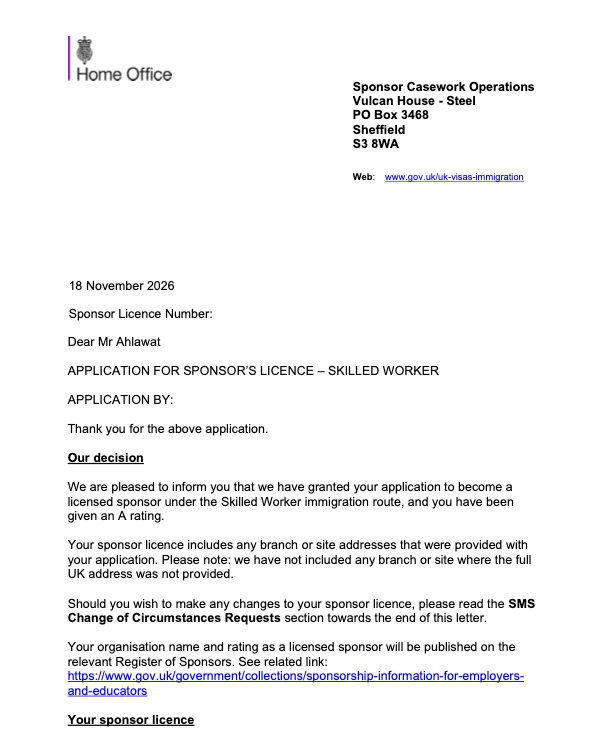
We are pleased to share that a UK construction company has been granted a sponsor licence within 3 days of submitting its documents, with help from Nara Solicitors.
The Home Office did not ask for any additional information. The licence came with one Certificate of Sponsorship (CoS), which will be used for one of the company's own directors.
This was a self-sponsorship case, and the timing mattered.
The director's visa was running out. Our client is a genuine construction company, trading lawfully in the UK. One of its directors was in the UK on a Graduate visa, often called the post-study work (PSW) visa.
His visa expires on 10 December. To keep working in the business after that, he needed a new route. The company decided to sponsor him under the Skilled Worker visa.
He was the right person for the role. The company has sustainable revenue and clear growth projections. The next stage of that growth needs someone who already knows the business from the inside.
The director does. He understands how the company works, and he has relevant qualifications and experience for the role.
Our client's view was simple: no outside hire could add as much to the company's growth as he could. That is the heart of a strong self-sponsorship case.
What the application needed to show. When the person being sponsored is also a director, the Home Office looks closely at whether the vacancy is genuine. It needs to see a real role that the business actually needs, not a job created only to secure a visa.
Our team prepared the sponsor licence application so the facts were clear from the start. It showed that the business is genuine and trading lawfully, that it can afford the role, and that the director is qualified for it.
The Home Office granted the licence within 3 days after the documents were submitted. No further information was requested.
With its CoS in place, the company can now sponsor the director for his Skilled Worker visa application before his Graduate visa ends.
If your own visa is running out and your business needs you to stay, book a consultation with our team to check where you stand.
Self-sponsorship is still possible. We often speak to business owners who assume they can no longer sponsor themselves. You can, if the facts support it.
Self-sponsorship through the Skilled Worker route can work when:
your business is genuine and operating lawfully in the UK
it has enough revenue to cover the cost of the sponsored worker, including their salary
the role is relevant to what the business does
the worker has the qualifications and experience the role needs
The role must also meet the usual Skilled Worker visa requirements on job type and salary. Self-sponsorship is not a shortcut around those rules.
A licence comes with duties. Once licensed, a self-sponsoring company has the same sponsor duties as any other licence holder. That includes keeping the right records and reporting changes to the Home Office on time.
Our sponsor licence compliance audit checks that your systems meet those duties. We also run the Sponsor Licence Compliance Guru tool, which helps sponsors keep track of their obligations between audits.
Similar cases we have handled. This is not the first self-sponsorship case we have taken on. You can read how we secured a sponsor licence for a management consulting company in a similar position, and how an IT consulting firm got its sponsor licence.
As immigration solicitors in London, we advise businesses across the UK on sponsor licences, self-sponsorship and Skilled Worker visas.
If you run a genuine business and want to know whether self-sponsorship could work for you, we can go through it with you.
Read more of our success stories, or book a consultation with Nara Solicitors today.