
After years of separation, a refusal of UK entry clearance and a dismissed appeal, a British family secured British citizenship for their adopted child.
Once a decision has gone against a family and the Tribunal has upheld it, it can seem that little remains to be done. That is not always so.
A setback of that kind does not necessarily mean that every available legal route has been closed.
Here, the family did not simply apply again.
Entering the overseas adoption in the Adopted Children Register, held by the General Register Office, altered the evidential position. It supported a successful application under section 3(1) of the British Nationality Act 1981.
The background
The child, an Indian national born in 2017, was legally adopted in India in 2018 by a couple, both British citizens, under the Hindu Adoptions and Maintenance Act 1956.
The adoption was formal. It was recorded in a registered adoption deed, supported by a District Magistrate's verification certificate and a support letter from the Central Adoption Resource Authority (CARA), and marked by a religious ceremony.
From that point, the birth parents' legal ties were severed under Indian law, and the adoptive parents assumed full parental responsibility.
Recognition did not come easily. The Indian passport authority refused to issue a passport, and the parents challenged it in the Punjab and Haryana High Court.
The family was represented by Mr Sukhvinder Nara, now Principal Solicitor of the firm, who was then practising as an Advocate before that Court.
In 2020, the Court held that the adoption was valid, irreversible and binding, and ordered that a passport be issued. The child's status under Indian law was no longer in doubt.
In July 2023, the family applied for UK entry clearance. The application was refused. The decision raised issues about recognition of the overseas adoption and whether the evidence showed the required parental relationship.
The family appealed. In 2024, the First-tier Tribunal dismissed the appeal. On the evidence then before it, the Tribunal was not satisfied that the adoption met the criteria for recognition for immigration purposes.
The child was recognised as their adopted daughter in India, but the UK proceedings had not enabled the family to reunite in Britain.
The consequences went beyond the paperwork. The adoptive mother, a British citizen, remained in India as the child's primary carer.
The adoptive father continued to live and work in the United Kingdom, supported the family financially, and maintained contact through visits. That arrangement continued for more than six years.
A different route
Any further application had to do more than repeat arguments and evidence that had already been considered. After the appeal was dismissed, the case was rebuilt.
We applied to the General Register Office for England and Wales to register the overseas adoption. The child was entered in the Adopted Children Register as the adopted daughter of her British parents.
That certified entry mattered. India is a designated country under the Adoption (Recognition of Overseas Adoptions) Order 2013, and the entry was independent support for the argument that the adoption was recognised under that Order.
It did not decide the citizenship application. It did change the evidence on a point that had stood in the way of entry clearance: whether the adoption was recognised in UK law.
The citizenship application
We then applied for registration of the child as a British citizen under section 3(1) of the British Nationality Act 1981.
Registration of a minor in these circumstances is discretionary. The Secretary of State had to be invited to exercise that discretion, and shown why it should be exercised.
The application dealt openly with the earlier refusal and the dismissed appeal. It did not seek to minimise them. The evidence and representations brought together:
the overseas adoption and the adoption documents
the Indian High Court proceedings on the validity of the adoption
the child's entry in the Adopted Children Register
proof of the adoptive parents' British citizenship
evidence of a genuine and continuing parent and child relationship
the mother's long-term care of the child in India
the father's continuing financial support from the UK
the circumstances of the previous refusal and appeal
the child's welfare, and the effect of the prolonged separation
The application explained what had changed since the earlier proceedings, and why the child's circumstances should now be considered under the British nationality framework.
She had been their daughter for seven years. It was argued that continued separation from her father, and from education and healthcare in the country of her parents' citizenship, should be weighed in the exercise of the discretion, now that the question of recognition had been addressed by new evidence.
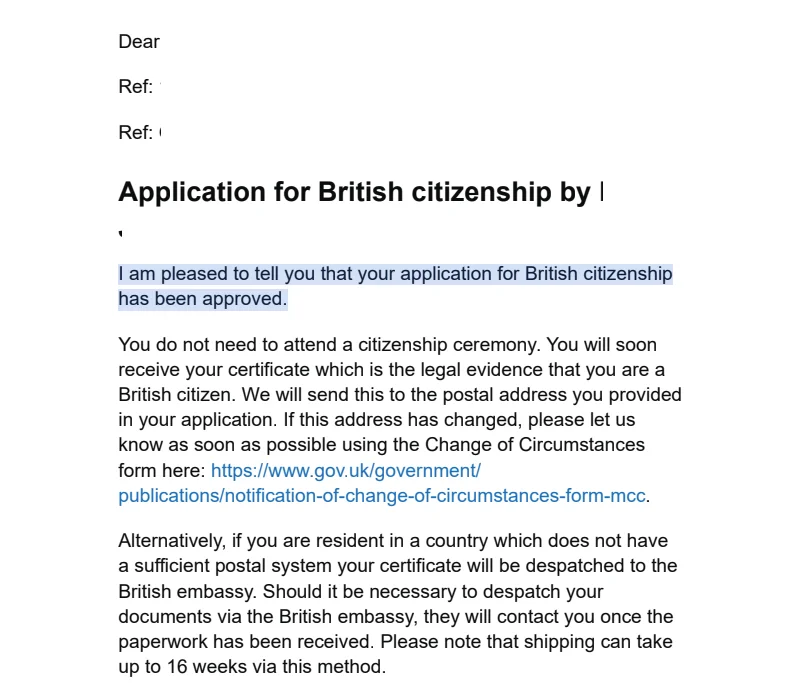
The application was granted. She was registered as a British citizen, and a British passport followed.
For the family, the decision ended years of uncertainty about their daughter's status. It removed a major legal barrier that had kept them divided between India and the United Kingdom.
Our journey
A complex immigration or nationality matter often needs more than another application on the same evidence. A change of strategy, a different legal route and robust new evidence may alter the position.
Here, later registration of the overseas adoption with the General Register Office materially changed the evidence. That allowed the child's circumstances to be presented through an application for registration as a British citizen.
What remained constant was the willingness to reassess the strategy after each refusal and setback, and to pursue a proper route as far as it could properly be taken.
Not least, a case of this length was possible only because of the parents' patience and trust. Their perseverance, over many years, mattered as much as the legal work.
If your family is dealing with an overseas adoption, a previous immigration refusal, or a question about a child's eligibility for British citizenship, we can review the history, advise on the options, and represent you where there is a proper route to take forward.
You can read more of our client outcomes on our success stories page.
Book a consultation with Nara Solicitors today.