
If the Home Office made a mistake when it refused your UK student visa, an administrative review can get the decision looked at again.
In the year to June 2026, seven countries accounted for 86% of all UK study visa refusals, according to Home Office data. If yours was one of them, here is how to work out whether you can challenge it.
What the Home Office data shows
The Home Office published its latest immigration statistics on 27 August 2026. They cover the year to June 2026.
In that year, 383,455 sponsored study visas were granted. That is 11% fewer than the year before.
China had the most main applicant grants with 86,368. India was close behind with 82,523, or 23% of the total. Nigeria came third with 26,060.
Grants fell by 47% for Pakistani students and by 16% for Indian students.
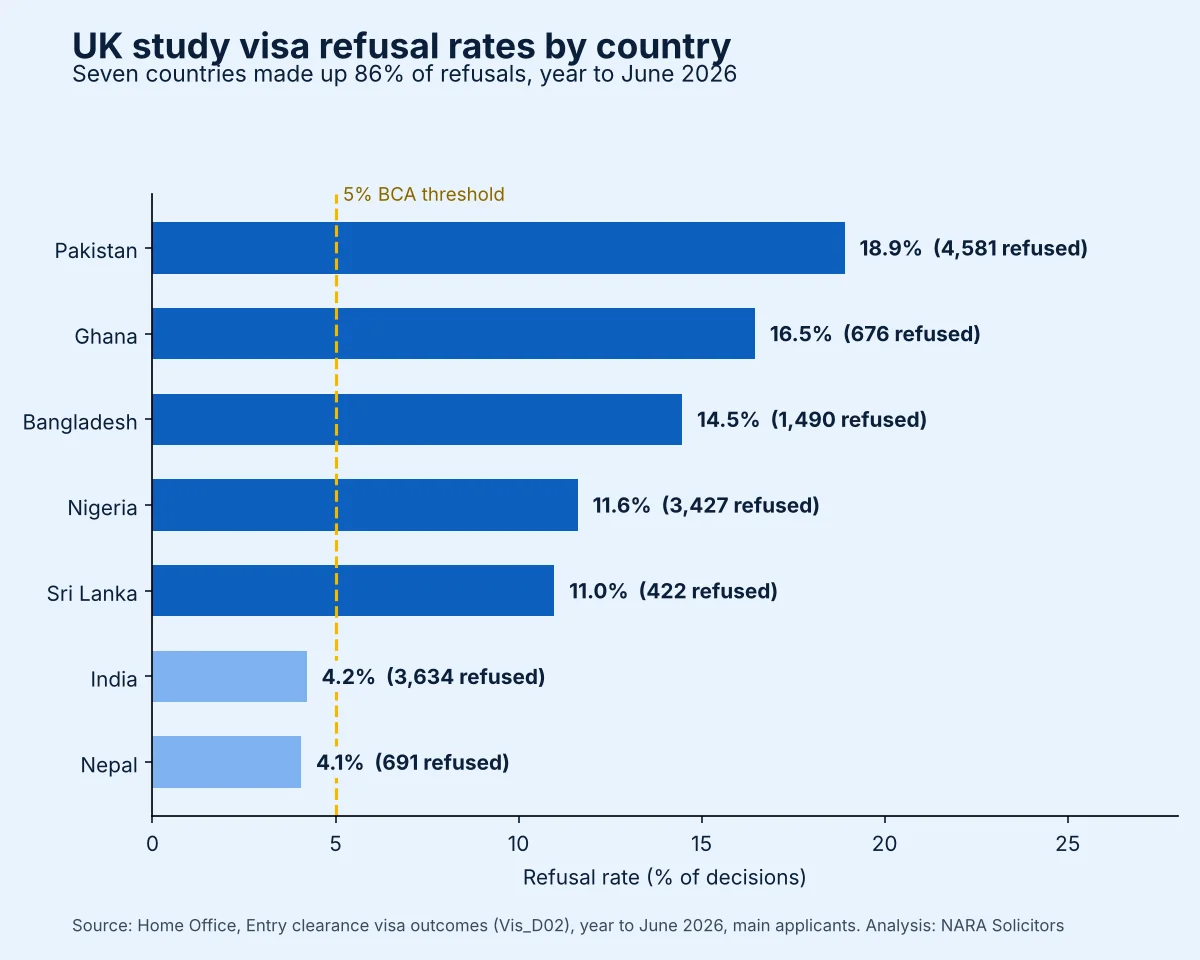
UK student visa refusal rates by country
The Home Office's detailed visa outcomes data shows 17,381 refusals of sponsored study visas for main applicants in the year to June 2026. That is 4.5% of all applications that were either granted or refused.
Most of those refusals came from seven countries: India, Nigeria, Pakistan, Bangladesh, Nepal, Ghana and Sri Lanka. Together they made up 86% of refusals. The PIE News first reported the pattern on 20 October 2026.
Nationality | Visas granted | Visas refused | UK student visa rejection rate |
|---|---|---|---|
India | 82,523 | 3,634 | 4.2% |
Nigeria | 26,060 | 3,427 | 11.6% |
Pakistan | 19,640 | 4,581 | 18.9% |
Bangladesh | 8,805 | 1,490 | 14.5% |
Nepal | 16,300 | 691 | 4.1% |
Ghana | 3,430 | 676 | 16.5% |
Sri Lanka | 3,421 | 422 | 11.0% |
Main applicants, year to June 2026. Rejection rate is refusals as a share of applications granted or refused. Figures from 2026 are provisional.
These yearly figures include the busy July to September 2025 period, when only 1.6% of study visa decisions were refusals. Rates went up after that. For Indian students, the refusal rate across October 2025 to June 2026 was 7.8%.
Why it is worth challenging a refusal
A refusal stays on your immigration history. You will need to declare it in future visa applications.
If the refusal was a Home Office mistake, an administrative review is the way to correct it. A successful review also helps your university.
Since 1 June 2026, universities must keep their visa refusal rate under 5% to pass the Home Office's annual compliance check. Under the Student sponsor compliance guidance, a student whose application is being reconsidered after a successful administrative review is left out of that refusal rate.
If you want a second opinion on your refusal, book a consultation with our team.
Refused? Check if you can ask for an administrative review
Start with your refusal letter. It will tell you whether you can ask for an administrative review.
The Student route is covered by Appendix Administrative Review of the Immigration Rules. Most Student visa refusals do not come with a right of appeal, so administrative review is usually the route to challenge one.
Deadlines
The time limit depends on where you applied:
Applied from outside the UK: 28 calendar days from the date you receive the refusal.
Applied from inside the UK: 14 calendar days.
Detained when you got the decision: 7 calendar days.
A late request can still be accepted if it would be unjust not to, and you applied as soon as you reasonably could. But do not rely on this. Act inside the deadline.
What an administrative review can and cannot do
An administrative review checks for a caseworking error. Under the rules, that means the caseworker either did not apply, or applied incorrectly, the Immigration Rules or the Home Office's published guidance.
The reviewer looks at the evidence you already sent. In most Student cases, you cannot add new documents.
There are a few exceptions. New evidence can be considered where you were refused for deception, or where the caseworker should have used the evidential flexibility policy and asked you for missing documents.
Refused because of your bank statement?
Many UK student visa refusal reasons relate to money. Under Appendix Finance, your most recent financial evidence must be dated within 31 days before the date of your application.
The funds can be in your own name or in a parent's or legal guardian's name. If you use a parent's account, you must show your relationship and their written consent.
If you met these rules and the caseworker still refused you, that may be a caseworking error. That is the kind of mistake an administrative review can correct.
What are your chances of success?
People often ask about the UK visa administrative review success rate. Your chances depend on one question: did the caseworker get the rules or guidance wrong?
If they did, and you can show it, you have a real case. If the refusal was down to something missing from your application, a review is unlikely to change the outcome. A solicitor can tell you quickly which side of that line your case falls on.
Can I apply again after a UK student visa refusal?
Yes, you can make a new application. But making any new visa application automatically withdraws an administrative review you have already made.
So decide your route first. If the refusal was a Home Office error, a review may be the better option. If something was missing, a fresh application that deals with every refusal reason may be the stronger choice.
How NARA Solicitors can help
Based in Canary Wharf, London, our team at NARA Solicitors has helped many students and individuals with their visa refusals. We review your refusal letter and tell you whether an administrative review has a real chance. If it does, we prepare the request. If a fresh application is the better route, we help you answer each refusal reason before you apply again.
Read how we got a visitor visa refusal overturned for one of our clients.
If your UK student visa has been refused, do not let the deadline pass. Book a consultation with NARA Solicitors today.