


A new government report has, for the first time, broken down what happens to migrants who come to the UK on a Skilled Worker visa.
The findings matter for any employer holding a sponsor licence and any migrant planning their route to settlement. Some of the patterns will be familiar to anyone working in immigration. Others change the way we should think about who builds a long-term life in the UK.
If you are a sponsor licence holder reviewing your workforce plan, or a Skilled Worker visa holder thinking about your route to settlement, the patterns in this report are worth understanding. Book a consultation with our team if you want to discuss what they mean for your situation.
What "stay rate" means in this report
One thing to be clear about up front. The report measures whether someone still holds valid UK immigration status, meaning a valid visa, indefinite leave to remain, or British citizenship. It does not directly measure whether they are physically still in the country. The UK does not have reliable exit checks, so the report assumes a person has left once their visa expires and is not renewed. Where we refer to migrants "staying" or having "remained," this is shorthand for holding valid immigration status, not confirmed physical presence.
Finding 1: Stay rates have risen with each new cohort
The five-year stay rate has been climbing steadily. Of migrants who arrived on this route in 2014, 74% still held valid UK immigration status five years later. For those who arrived in 2019, that figure rose to 85%.
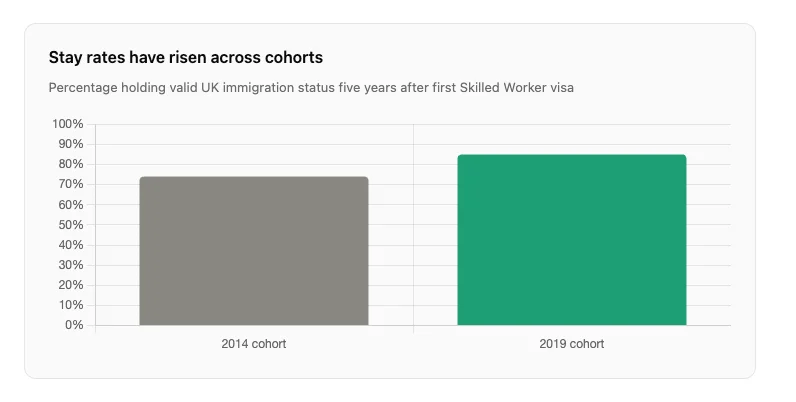
The regression analysis confirms this is not just because newer cohorts have a different mix of people. Compared to 2014 as a reference year, the odds of holding valid status after five years rose to 1.27 times in 2015, 1.36 in 2016, 1.50 in 2017, 1.70 in 2018, and 1.91 in 2019. These are statistically significant findings even after controlling for age, industry, nationality, and other factors.
Importantly, the trend began well before the post-Brexit immigration changes of December 2020. It is not driven by any single policy change.
Finding 2: Health and care workers are far more likely to stay than anyone else
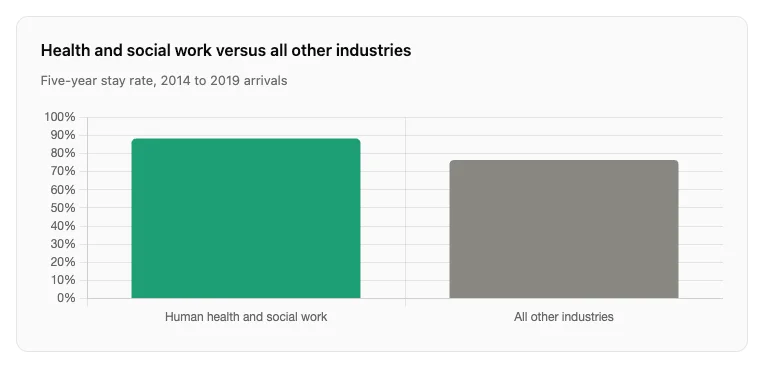
The single biggest difference in stay rates is between industries. Migrants working in human health and social work activities had an 88.2% five-year stay rate. For migrants in all other industries combined, the figure was 76.4%.
Within healthcare, the standout finding is nurses. 94% of nurses who arrived on a Skilled Worker visa still held valid UK immigration status five years later, the highest stay rate of any common occupation in the data.
At the opposite end, "natural and social science professionals" (SOC 2010 code 2119) had the lowest stay rate among common occupations at just 57%. The MAC notes that this occupational category is dominated by academic researchers, as all employers in this SOC code sponsoring more than 100 visas in the data were universities.
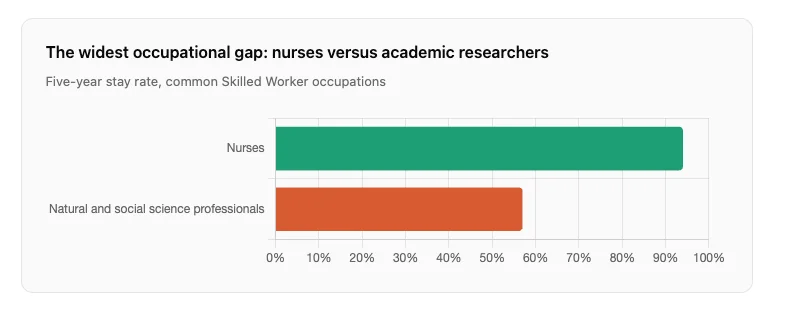
The regression analysis backs this up. Compared to all other occupations, nurses had an odds ratio of 3.93 (significantly higher odds of staying), while natural and social science professionals had an odds ratio of just 0.35.
Care workers and home carers, who were only added to the Skilled Worker route in 2022, also show very high early stay rates. There is not yet enough data to know whether this will hold over the longer term.
The MAC suggests several reasons for the high healthcare retention. These include strong, sustained labour demand in the NHS and social care, the administrative burden of transferring nursing and medical licences to another country, the higher number of dependants that health and care visa holders tend to bring with them, and the female-skewed gender mix in healthcare (women generally have higher stay rates).
What this means for sponsors: If you hold a sponsor licence in health or social care, the data confirms what many in the sector already know. These workers tend to commit to longer stays, which has implications for workforce planning, retention strategies, and how you support staff through the route to settlement. Our team handles sponsor licence applications and ongoing compliance audits for care providers regularly.
Finding 3: Age matters, with a sharp drop above 45
There is a clear pattern. People who arrive in the UK at age 45 or older are less likely to retain valid status long term.
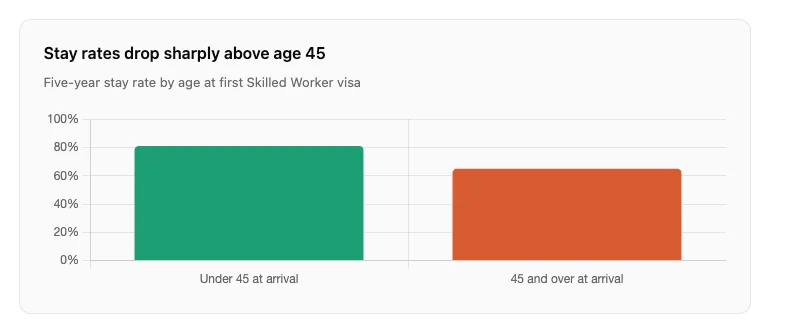
Among those under 45, there is very little difference between age bands. The drop-off starts above 45 and becomes more pronounced for those over 55.
The MAC's regression analysis shows the relationship is actually U-shaped once you control for other factors. Compared to those entering aged under 25, the odds ratios were:
Age 25 to 34: 1.31 (higher odds of staying)
Age 35 to 44: 1.14 (higher odds of staying)
Age 45 to 54: 0.85 (lower odds)
Age 55 and over: 0.53 (significantly lower odds)
Finding 4: Salary, the counterintuitive finding
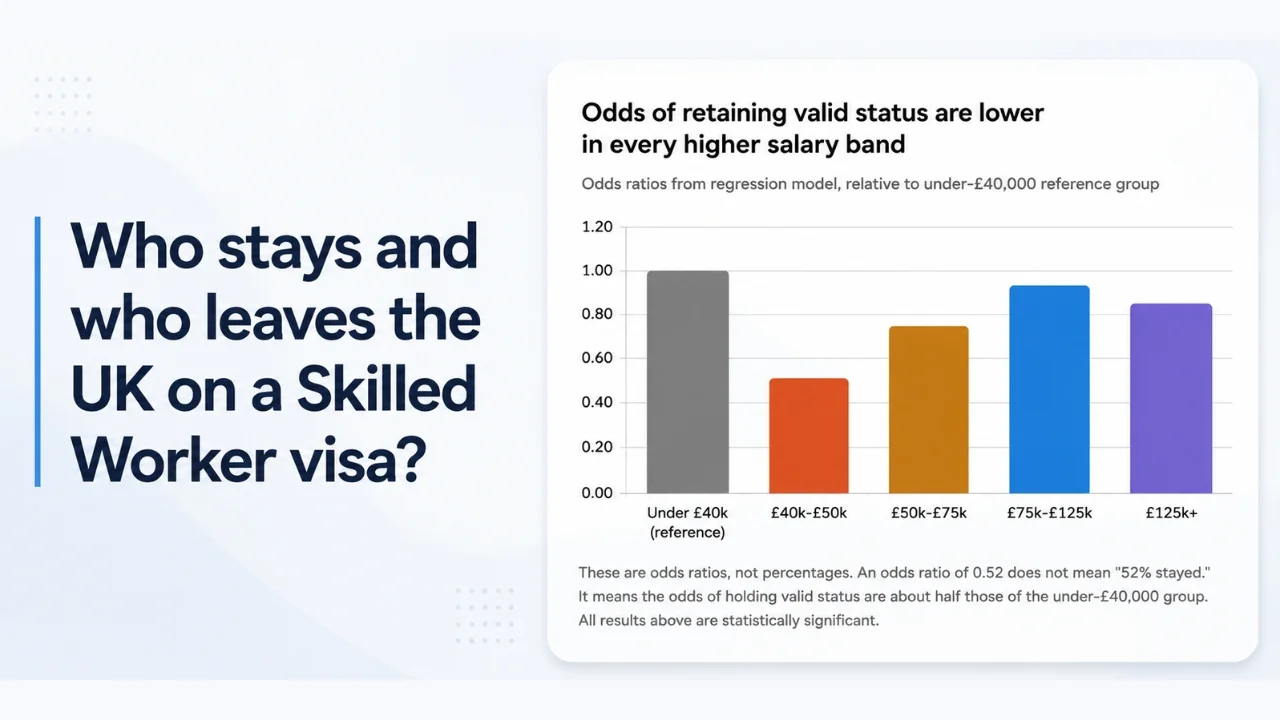
This is one of the report's most striking findings. The common assumption is that the UK retains higher earners more easily. The data shows the opposite.
Migrants who arrived earning less than £40,000 per year had the highest stay rates of any salary group. When the MAC's regression model compared other salary bands to this under-£40,000 reference group, every higher band had lower odds of staying.
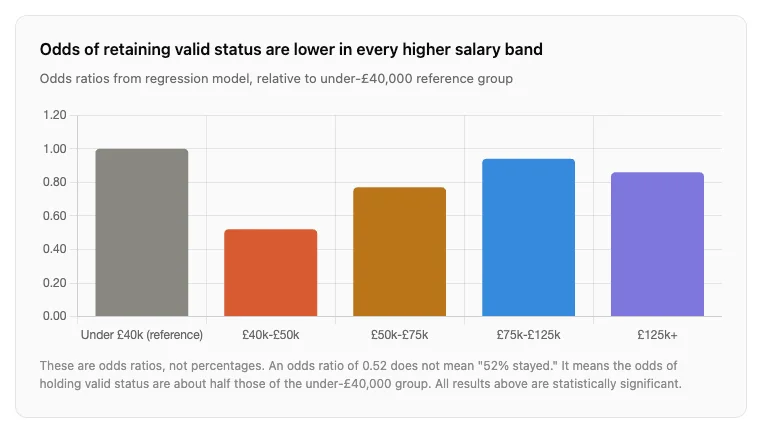
The MAC suggests that high earners have more global career options and lower financial barriers to moving elsewhere. Lower earners may have less mobility, stronger ties to communities they have built in the UK, and fewer reasons to relocate.
There is a technical caveat worth knowing. The highest earners are often granted longer initial visas. 35% of those earning £125,000 or more get a five-year visa from the start, compared to just 12% of those earning under £75,000. This means some high earners may have already left the UK before their visa officially expired, and the report believes the true stay rate for high earners is even lower than the headline figures suggest.
Finding 5: Women are more likely to stay than men
After five years, women on Skilled Worker visas were approximately five percentage points more likely to still hold valid UK immigration status than men. The regression analysis gives women an odds ratio of 1.27 (statistically significant higher odds) compared to men.
The gap appears in the first few years after arrival and then stabilises around the six-year mark, which is when most people become eligible for settlement.
The MAC notes that the gender pattern partly overlaps with industry. Across the full sample, 61% of women work in human health and social work activities, compared to 32% of men. The Home Office data does not currently allow main applicants to be linked to their dependants, which may explain some of the gender gap if women are more likely to migrate with children.
Finding 6: Where you apply from matters
People who applied for their Skilled Worker visa from inside the UK (typically switching from a student or graduate visa) were significantly more likely to hold valid status five years later than people who applied from outside the UK. The regression gives out-of-country applications an odds ratio of 0.71 compared to in-country applications.
This makes intuitive sense. Someone already in the UK has had time to build language skills, social networks, and a sense of whether they want to stay. By the time they apply for a Skilled Worker visa, they have already made an active choice to remain.
The data also shows that the route into the Skilled Worker visa has changed over time:
Among those who switched in-country between 2014 and 2020, 80% came directly from the Student visa route and 11% from the Tier 1 Post-Study route
Among those who switched in-country between 2021 and 2024, 54% came from the Student route, 23% from the Graduate route, 6% from Intra-Company Transfer, 3% from the Youth Mobility Scheme, and 2% were dependants
Overall, the share transferring from student or graduate routes fell from 91% in the earlier period to 77% from 2021 onwards
Switching from a student or graduate visa to a Skilled Worker visa is a common path, but the rules around it can be complex. Our team handles Skilled Worker visa applications for both new arrivals and in-country switchers. Book a consultation to discuss your route.
Finding 7: Nationality and country wealth matter
Stay rates vary significantly by nationality. Migrants from the USA, China, and South Africa were less likely to retain valid immigration status over time than migrants from Nigeria, Ghana, and Bangladesh.
When the MAC plotted five-year stay rates against the wealth of each migrant's home country (measured by GDP per capita in purchasing power parity terms), it found a pattern. Migrants from richer countries are, on average, less likely to remain. GDP per capita alone explains 29% of the variation in stay rates between nationalities (R² = 0.29).
However, the relationship is not absolute. Singapore is a very wealthy country, but Singaporean migrants have similar stay rates to those from South Africa and Sri Lanka.
The regression analysis grouped nationalities by region. Compared to non-EU European nationalities (the reference group), the odds ratios were:
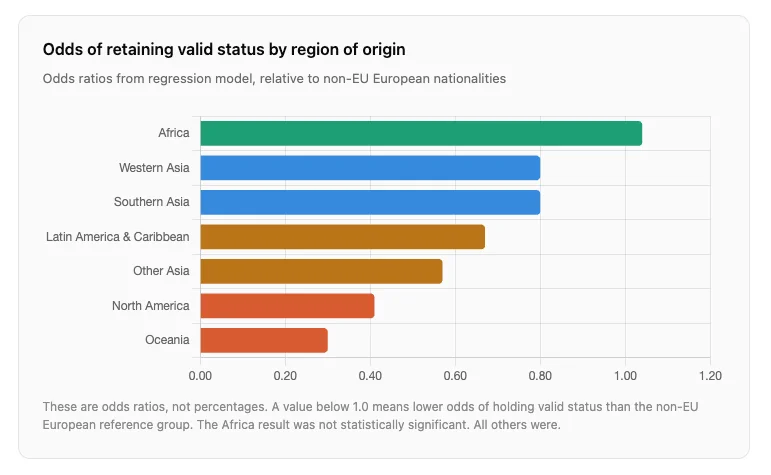
Migrants from Africa, Western Asia and Southern Asia have the highest relative stay rates (close to or just below the European reference group). Migrants from Oceania (OR 0.30) and North America (OR 0.41) have the lowest relative odds.
Finding 8: UK regions show some differences
After five years in the UK, stay rates are between 80% and 83% for those working in all UK nations and regions except for the South East (79%), Yorkshire and the Humber (78%), Wales (78%), and Scotland (73%).
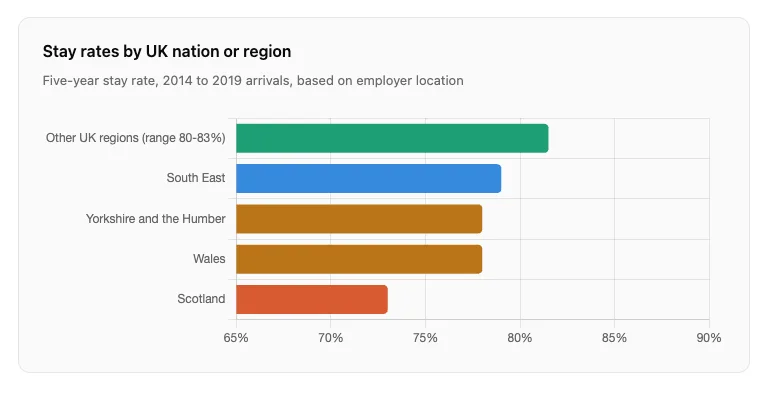
The regression analysis confirms this pattern. Using London as the reference, all other UK nations and regions had lower odds of retaining migrants after five years. The lowest odds ratios were for Wales (0.72) and Scotland (0.76).
The MAC offers no firm explanation for why Scotland and Wales retain migrants less well, and says this should be explored further in future research. One caveat is that the location data is based on the employer's registered address, not where the migrant actually lives or works day-to-day, so remote and hybrid working may complicate the picture.
What this means for sponsors and migrants
The report lands at a politically significant moment. The UK government is currently developing proposals for "earned settlement," a system under which migrants would have shorter or longer routes to permanent residence based on their earnings, language proficiency, and other factors. The 2025 Immigration White Paper also raised the skill threshold back to graduate level (RQF 6), raised salary thresholds, and closed adult social care applications from overseas.
For sponsor licence holders, the key takeaways are:
If you sponsor in health and social care, your workers are likely to commit to long stays, which supports workforce planning but means compliance discipline matters even more. A compliance audit can help ensure you stay on top of duties.
If you sponsor in higher education or research, expect higher turnover. Short academic contracts and internationally mobile careers mean stay rates are well below other sectors.
If you sponsor in high-paying roles, do not assume the salary alone secures retention. The data shows higher earners are more likely to move on.
If you have switched to sponsoring more recent arrivals, the upward trend in stay rates suggests these workers are more committed than earlier cohorts.
For Skilled Worker visa holders, the patterns also have practical implications:
Settlement rules may change under the proposed "earned settlement" framework. Higher earners and academics may face longer routes to settlement under the new proposals.
Switching from a student or graduate visa to a Skilled Worker visa is a well-established path, and people who go this route are statistically more likely to settle.
Care workers and nurses currently show the strongest retention, but policy changes from 2024 and 2025 have already tightened the care worker route.
The Skilled Worker route is changing fast, and the rules for sponsor licences, salary thresholds, and settlement are not what they were even two years ago. Whether you are an employer reviewing your sponsor obligations or a visa holder planning your route to ILR, book a consultation with NARA Solicitors to discuss your specific situation.
About the Migration Advisory Committee and this report
The Migration Advisory Committee (MAC) is an independent body that advises the UK government on migration policy. This report, titled "Who stays, who leaves? Evidence from administrative records on the Skilled Worker route," was published on 12 May 2026.
The MAC analysed Home Office administrative records covering 916,000 unique migrant journeys. These were people who arrived in the UK as the main applicant on a Tier 2 (General) visa, a Skilled Worker visa, or a Health and Care Worker visa between 2014 and 2024. The report refers to all three collectively as "Skilled Worker visas."
The researchers combined three datasets: Migrant Journey data (which tracks each person's visa history), visa application data, and Certificate of Sponsorship (CoS) data (which contains details about the employer, job, and salary). They successfully linked 97% of records, with 888,000 of the 916,000 journeys having a complete set of demographic and work characteristics.
Limitations to keep in mind
The MAC is transparent about several limitations:
"Stay" means holding valid immigration status, not physical presence. Some people may leave the UK before their visa expires, while others may overstay. The data cannot distinguish these cases.
The detailed regression analysis only covers 2014 to 2019 arrivals, all under the old Tier 2 (General) system. The findings cannot automatically be applied to people who arrived under the post-2020 Skilled Worker route.
Dependants are not yet linked to main applicants. The analysis only covers the main visa holder, not their family members.
Deaths are not recorded in the data. If a migrant dies while holding a valid visa, the data treats them as having left the UK.
Some other Tier 2 categories are excluded, including Intra-Company Transfer, Sportsperson, and Minister of Religion visas.
Source: Migration Advisory Committee, "Who stays, who leaves? Evidence from administrative records on the Skilled Worker route," published 12 May 2026.
Full report available on gov.uk: Read the full report on gov.uk